
Introduction – Why Follow a Bug Bounty Hunter Roadmap?
So, you want to hack legally and get paid for it? Welcome to the world of bug bounty hunting.
This is not just a trend—it’s a growing industry. According to HackerOne, companies have paid out more than $300 million in rewards to ethical hackers worldwide. Some hunters are even making six-figure incomes just by finding security bugs in popular platforms.
The best part? You don’t need to be a computer science genius to start. With the right roadmap, anyone with curiosity and persistence can become a bug bounty hunter.
In this guide, you’ll discover the complete Bug Bounty Hunter Roadmap—a step-by-step plan to learn ethical hacking, join real programs, and earn your first reward. By the end, you’ll know exactly how to go from beginner to paid hacker, without breaking the law.
Let’s dive in. 🚀
What is Bug Bounty Hunting? (Definition, Meaning & Importance)
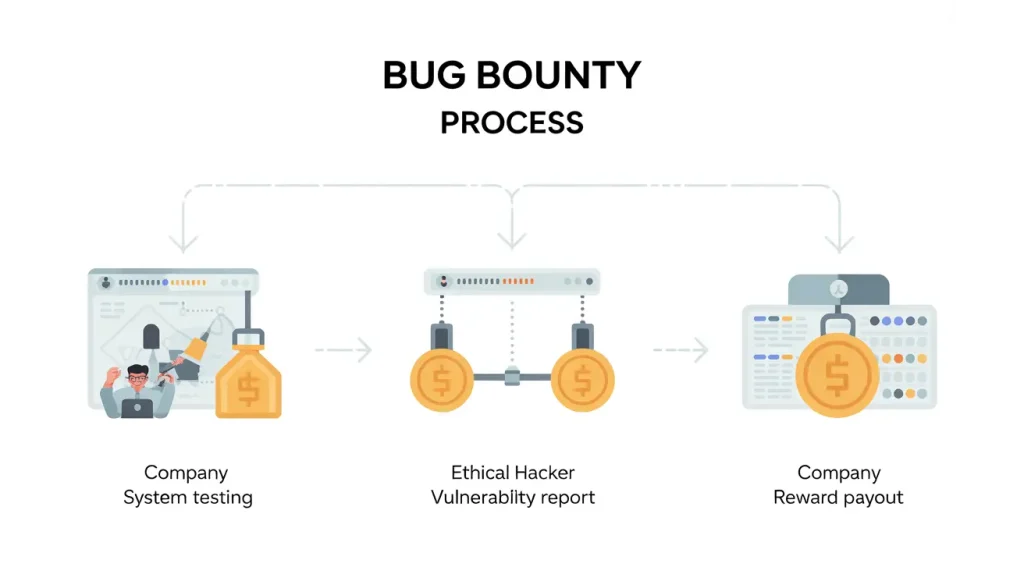
Definition and Meaning
A bug bounty is a program where companies invite ethical hackers to test their websites, apps, and systems for weaknesses. If you find a valid security bug and report it responsibly, the company rewards you with money, recognition, or sometimes both.
A Bug Bounty Hunter is the person who participates in these programs. They are not criminals. They are security researchers who hack legally. They follow the rules of the platform and the company’s scope.
The Bug Bounty Hunter Roadmap is simply a structured path to go from a beginner with little or no hacking experience, to a skilled professional who can earn real rewards.
History of Bug Bounties
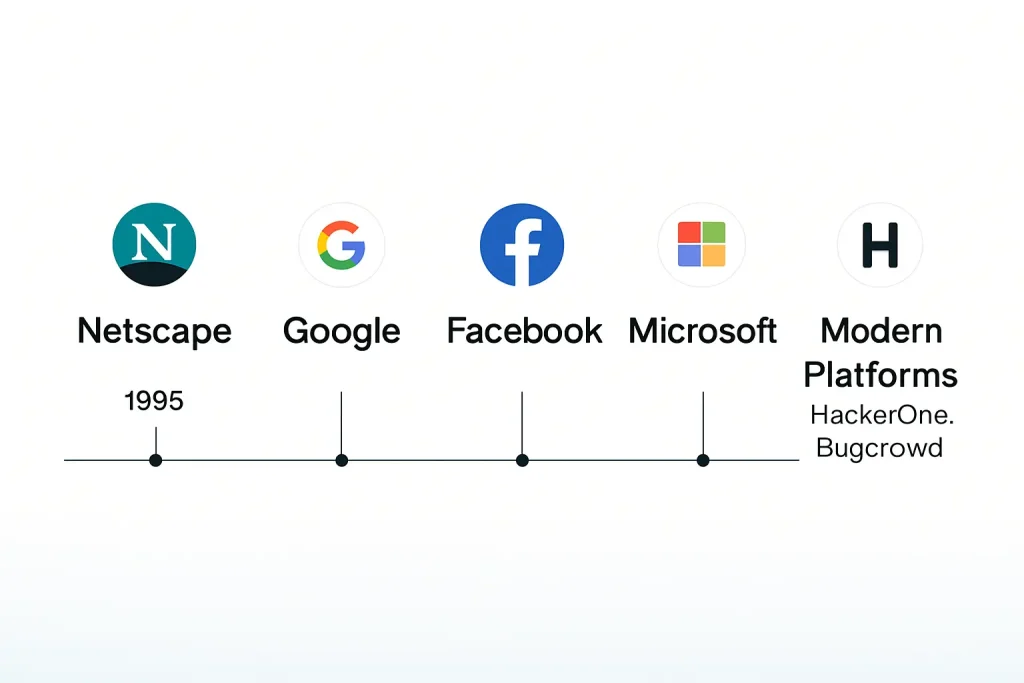
The first bug bounty program was launched in 1995 by Netscape. It was a bold idea: “Let’s pay outsiders to break our product before criminals do.”
Over time, big tech companies like Google, Facebook, and Microsoft adopted bug bounty programs. Today, platforms like HackerOne, Bugcrowd, and Intigriti manage thousands of bounty programs. Some hackers have earned millions of dollars through these programs.
This shows how bug bounty hunting is not just a hobby, but a recognized career path.
Why Companies Run Bug Bounty Programs
- Cost-effective Security – Hiring thousands of full-time testers is impossible. But opening a bug bounty allows thousands of hackers worldwide to test systems for free, and the company only pays for real, valid bugs.
- Diverse Skillsets – Hackers from different backgrounds use different methods. This brings creativity to security testing.
- Faster Discovery – More eyes on a system means vulnerabilities are found quicker.
- Reputation & Trust – Running a bug bounty shows users that the company takes security seriously.
Bug Bounty vs Penetration Testing
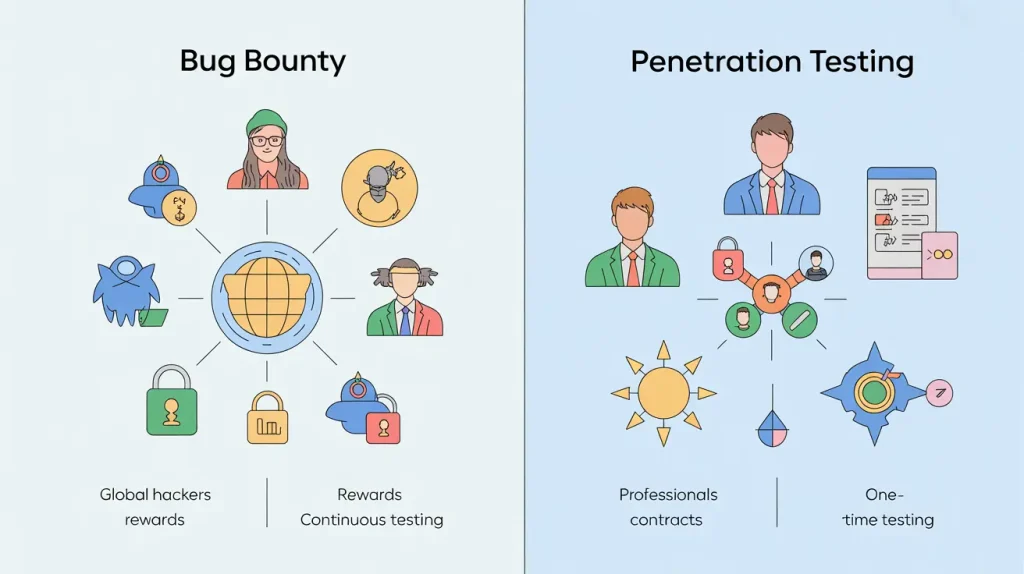
Bug bounties are often confused with penetration testing. But there are clear differences:
| Bug Bounty Hunting | Penetration Testing |
|---|---|
| Open to global hackers | Done by hired professionals |
| Continuous testing | One-time project |
| Pay-per-bug | Fixed contract |
| No guaranteed bugs found | Guaranteed testing report |
Both are important. But bug bounty hunting brings scale, diversity, and real-world coverage.
Why Bug Bounty Hunting Matters in 2025
Growth of the Cybersecurity Market
Cybercrime damages are projected to cost the world $10.5 trillion annually by 2025. Companies cannot ignore security anymore.
Bug bounty programs are growing as a result. Platforms like HackerOne report hundreds of new hackers joining daily.
This means demand is high. And if you follow the Bug Bounty Hunter Roadmap, you can position yourself as a valuable security researcher.
Bug Bounty Hunter Roadmap – Step-by-Step Guide
The Bug Bounty Hunter Roadmap is like a journey. You start as a beginner, learn the basics, build skills, join platforms, and finally earn rewards. Let’s break it down into clear steps so you can follow and grow.
Step 1: Learn the Fundamentals (Your First Building Blocks)
Imagine trying to break into a digital fortress without even knowing what the walls are made of. That’s what bug bounty hunting feels like if you skip the fundamentals.
Every Bug Bounty Hunter Roadmap starts here: understanding how the internet works. Before tools, before reports, before hacking — you need the language of the web.
✅ What to Learn First:
- Networking basics → IP addresses, DNS, HTTP/HTTPS, ports.
- Web technology → HTML, CSS, JavaScript, backend frameworks.
- Linux basics → Most hacking tools run on Linux. Learn to use the terminal, commands, and file systems.
💡 Pro Tip: Don’t rush. Use free platforms like TryHackMe, HackTheBox, and PortSwigger Academy to build your foundation. Think of these as your hacker gym where you train before stepping into the real fight.
This first step might feel “boring,” but it’s your strongest weapon later. Without it, everything else in the Bug Bounty Hunter Roadmap will feel like a foreign language.
Step 2: Understand the Mindset of a Hacker (Think Like an Attacker)
Bug bounty hunting is not about pushing buttons or running tools blindly. It’s about curiosity and persistence.
A good hacker doesn’t ask, “Does this work?” They ask, “What happens if I break this rule?”
👉 Examples of a hacker’s mindset:
- See a login form? Instead of just logging in, you ask: What if I add special characters? Can I bypass it?
- See a file upload feature? You think: What if I upload something the system doesn’t expect?
- See an API? You wonder: What if I send a request the app wasn’t designed to handle?
💡 Pro Tip: Train your brain like a puzzle solver. Every button, every input field, every hidden parameter could be a key to something bigger.
Remember — the Bug Bounty Hunter Roadmap is not just about tools. It’s about learning to see the web like an attacker would.
Step 3: Set Up Your Hacker Lab (Safe Testing Environment)

Before you can test real websites, you need a safe playground—a hacker lab. Think of it like a flight simulator for pilots. You get to practice, crash, and experiment without causing damage in the real world.
A proper lab is one of the most important parts of the Bug Bounty Hunter Roadmap. It lets you test tools, break things, and rebuild them until you master the basics. Without it, you’ll be learning blindly.
Here’s how to build one:
- Choose Your Environment
- Install VirtualBox or VMware so you can run multiple operating systems on your computer.
- Most hunters use Kali Linux, which comes with hacking tools pre-installed.
- Set Up Targets
- Don’t hack random websites. Instead, practice on safe platforms like DVWA (Damn Vulnerable Web App) or bWAPP.
- These are purposely weak systems designed for learning.
- Use Snapshots
- Break something? No problem. With snapshots, you can restore your system in seconds.
- Experiment Daily
- Run Nmap scans, try SQL injection, play with Burp Suite. The more you experiment, the faster you’ll improve.
🔑 Pro Tip: Treat your hacker lab like your gym. The more reps you do, the stronger you get. Every great bounty hunter started here.
Step 4: Master Web Application Security Basics (OWASP Top 10)
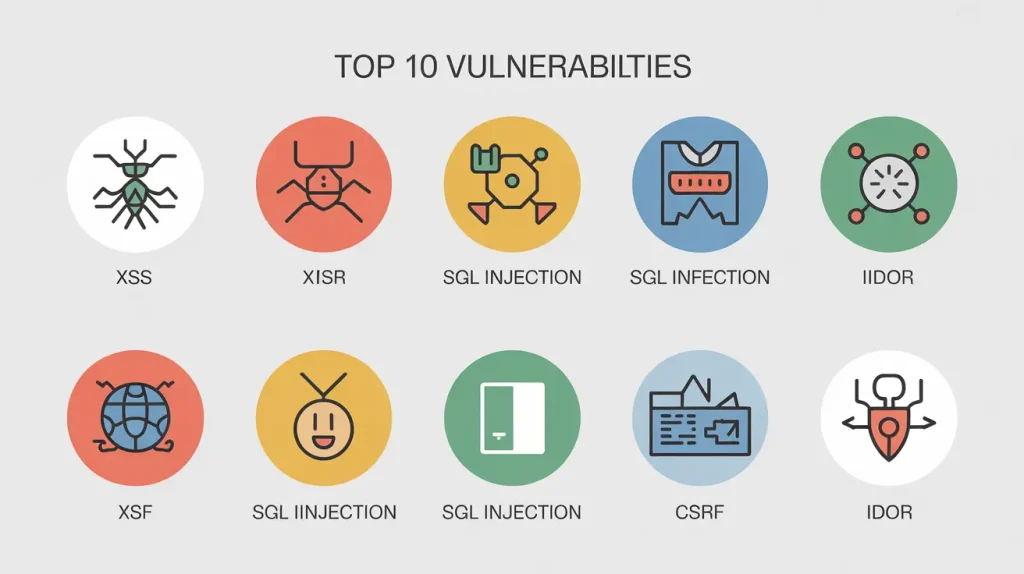
Most bug bounties focus on web apps. So, you must master web vulnerabilities. The OWASP Top 10 is your map.
Some common ones include:
- XSS (Cross-Site Scripting) – injecting scripts into pages.
- SQL Injection – manipulating database queries.
- CSRF (Cross-Site Request Forgery) – tricking users into unwanted actions.
- IDOR (Insecure Direct Object Reference) – accessing data you shouldn’t see.
👉 Example: On Facebook, if you could change a user ID in the URL and access another person’s private photos, that’s an IDOR bug.
These vulnerabilities are the core skills in the Bug Bounty Hunter Roadmap.
Step 5: Best Bug Bounty Platforms for Beginners
You can’t just hack any site you want. That would be illegal. Instead, join trusted platforms:
- HackerOne – the biggest community of ethical hackers.
- Bugcrowd – great for beginners, with many programs.
- Intigriti – popular in Europe, rising fast.
- YesWeHack – another solid platform.
👉 Start with public programs that allow beginners. Don’t jump directly into private programs until you build a profile.
This is a major milestone in the Bug Bounty Hunter Roadmap.
Step 6: Understand Scope & Rules of Engagement
Every program has a scope and policy. Scope defines what you can test. Policy defines how you should report bugs.
- Only test apps, APIs, and systems listed as “in scope.”
- Don’t attack production servers in ways that cause downtime.
- Don’t test employees or social engineer people.
- Always report responsibly.
Breaking these rules could get you banned. Following them keeps you safe and trusted.
Step 7: Reconnaissance Techniques (Recon for Beginners)
Recon is about finding hidden doors in a system. The more entry points you find, the better your chances.
Tools to use:
- Amass – for subdomain discovery.
- Nmap – for port scanning.
- Subfinder – for finding hidden assets.
- Burp Suite – for intercepting requests.
👉 Example: Imagine a company lists example.com as in scope. Recon might help you find dev.example.com, test.example.com, or api.example.com. These often contain juicy bugs.
Recon is the secret weapon of successful hunters.
Step 8: Exploit & Test Vulnerabilities Responsibly
Now comes the fun part. Once you’ve mapped the system, start testing for vulnerabilities.
- Use Burp Suite Intruder for parameter testing.
- Try payloads for XSS and SQL Injection.
- Look for broken access control (IDOR, privilege escalation).
- Explore APIs for misconfigurations.
⚠️ Warning: Always test within allowed scope. Responsible hacking is the backbone of the Bug Bounty Hunter Roadmap.
Step 9: How to Write a Professional Bug Bounty Report
Finding a bug is only half the job. Writing a clear report is the other half.
A great report includes:
- Summary – what you found and its impact.
- Steps to Reproduce – clear, step-by-step instructions.
- Proof of Concept (PoC) – screenshots, payloads, or short videos.
- Suggested Fix – help the company solve it.
👉 Example: Instead of writing “I found XSS in your login”, write:
“Reflected XSS in login page allows attacker to execute JavaScript by injecting payload into the username field.”
Reports that are clear and professional get rewarded faster.
Step 10: Earn Your First Bug Bounty Reward
Once your report is accepted, you will receive:
- A bounty (cash) – ranges from $50 to $50,000 depending on severity.
- Recognition – listed on a Hall of Fame.
- Reputation points – which unlock access to private programs.
Congratulations! You just completed the beginner phase of the Bug Bounty Hunter Roadmap.
Step 11: Keep Practicing, Level Up & Avoid Burnout
Bug bounty hunting is a skill that grows with practice. Don’t stop after your first reward.
- Join Capture the Flag (CTF) competitions.
- Read public disclosure reports on HackerOne.
- Collaborate with other hunters.
- Learn advanced topics like mobile hacking, API hacking, and cloud security.
Consistency turns beginners into experts.
Essential Skills in the Bug Bounty Hunter Roadmap
The Bug Bounty Hunter Roadmap is not just about tools and platforms. It is also about skills. Tools change with time. But skills stay forever. If you want to succeed in bug bounty hunting, you need to master certain abilities step by step.
Let’s go through them one by one.
1. Networking & Web Fundamentals
Every hacker must understand how computers talk to each other. Networking is the foundation.
- IP addresses – Know how computers are identified online.
- DNS (Domain Name System) – Learn how domains resolve into IPs.
- Ports and Protocols – Services run on ports (e.g., HTTP on port 80, HTTPS on port 443).
- HTTP & HTTPS – Understand requests, responses, headers, and cookies.
👉 Example: If you see a web app using HTTP instead of HTTPS, you already know there’s a weakness in data security.
This is a must for the Bug Bounty Hunter Roadmap, because most vulnerabilities live in how data moves across networks.
2. Linux & Command Line Skills
Most bug bounty tools are made for Linux environments. If you avoid Linux, you’ll miss 70% of hacking opportunities.
Key commands to learn:
ls,cd,pwd– for navigation.grep,find– for searching files.curl,wget– for making HTTP requests.chmod,chown– for permissions.
👉 Example: Recon tools like Amass or Subfinder often run best in Linux. Knowing terminal commands will make your workflow fast and smooth.
In the Bug Bounty Hunter Roadmap, Linux skills act like your hacker’s toolbox.
3. Programming & Scripting
You don’t need to be a senior developer. But you should be able to read and write simple scripts.
- Python – Great for automation and writing exploits.
- JavaScript – Needed for XSS, DOM attacks, and web exploitation.
- Bash – For quick automation in Linux.
- SQL – For testing SQL injection vulnerabilities.
👉 Example: If you can write a Python script to brute-force subdomains or test payloads, you’ll save hours of manual work.
Coding is like a booster engine in the Bug Bounty Hunter Roadmap. It multiplies your efficiency.
4. Web Application Security
Most bug bounty programs are web-based. That means you need to understand how websites and apps are built and where they break.
Study these areas:
- Authentication & Sessions – How login systems work.
- Input Validation – Where users enter data (and attackers inject code).
- APIs – How mobile and web apps exchange data.
- Cloud Services – AWS, GCP, and Azure are common targets.
👉 Example: If an app forgets to validate user input, you can inject malicious code. This simple mistake leads to XSS or SQL injection.
The Bug Bounty Hunter Roadmap requires you to become fluent in spotting these weak points.
5. Exploitation Techniques
Once you know how apps work, you need to practice how they break.
Top skills to learn:
- Cross-Site Scripting (XSS) – Injecting JavaScript into web pages.
- SQL Injection – Manipulating databases through queries.
- Cross-Site Request Forgery (CSRF) – Forcing actions without consent.
- Server-Side Request Forgery (SSRF) – Making servers fetch external data.
- Remote Code Execution (RCE) – Running commands on a server.
👉 Example: In 2022, a simple SSRF bug allowed a researcher to gain access to an internal AWS server of a company. The bounty was $30,000.
Exploitation is the sharp weapon in your Bug Bounty Hunter Roadmap.
6. Reconnaissance & Information Gathering
Finding hidden assets is an art. The best hunters are often the best at recon.
Skills to develop:
- Subdomain enumeration – finding new entry points.
- Directory brute-forcing – finding hidden pages.
- API discovery – mapping endpoints.
- Passive recon – using search engines, GitHub, and archives.
👉 Example: If you discover a forgotten staging server during recon, it may have weak security. That’s often where big rewards are found.
Recon is where most bug bounty hunters spend 60% of their time. It’s a cornerstone of the Bug Bounty Hunter Roadmap.
7. Reporting & Communication
Many beginners fail because they don’t know how to write reports. Remember:
- A messy report may get ignored.
- A clear report earns trust and faster payouts.
Essential reporting skills:
- Be concise but complete.
- Use screenshots, videos, or PoC scripts.
- Suggest fixes when possible.
👉 Example: If you report an SQL injection but don’t explain how to reproduce it, the company may reject it.
Professional reporting is a career skill in the Bug Bounty Hunter Roadmap.
8. Soft Skills & Persistence
Hunting bugs is not just technical. It also requires patience and persistence.
- Time management – Decide how much time to spend on one program.
- Persistence – Many bugs require hours of testing.
- Ethics – Stay within scope, never cross the legal line.
- Community – Share knowledge and learn from others.
👉 Example: Some hunters spend weeks on a single program and then discover a bug worth $20,000. Persistence pays.
9. Staying Updated
Cybersecurity is a fast-moving world. New vulnerabilities appear almost every week.
Stay updated by:
- Reading security blogs (PortSwigger, HackerOne Hacktivity).
- Following bug bounty hunters on Twitter/X.
- Joining communities on Discord, Reddit, or Telegram.
- Practicing new labs and CTFs regularly.
👉 Example: The Log4j vulnerability in 2021 was a massive event. Hackers who stayed updated earned huge rewards by finding it in different companies’ apps.
Staying updated is the lifelong part of the Bug Bounty Hunter Roadmap.
Summary of Skills
To recap, the essential skills for the Bug Bounty Hunter Roadmap are:
- Networking basics
- Linux & command line
- Programming & scripting
- Web application security
- Exploitation techniques
- Reconnaissance
- Professional reporting
- Persistence & ethics
- Staying updated
With these skills, you are not just a beginner. You are on the path to becoming a serious bug bounty hunter.
Tools of a Modern Bug Bounty Hunter
The Bug Bounty Hunter Roadmap is not complete without tools. Skills are the brain. Tools are the hands. You need both.
Let’s go through the categories of tools that every bug bounty hunter should know.
Reconnaissance Tools
Recon is about mapping out your target. These tools help you discover assets, subdomains, and hidden points of entry.
- Amass – One of the best tools for subdomain enumeration.
- Subfinder – Fast and reliable subdomain discovery.
- Nmap – Classic network scanner for ports and services.
- Assetfinder – Quick discovery of related domains.
- Shodan – Search engine for devices and servers.
👉 Example: Using Amass on example.com may reveal admin.example.com. That subdomain could contain a forgotten admin panel with weak security.
Vulnerability Scanning Tools
Once you find targets, you need to check them for weaknesses.
- Nikto – Web server scanner for misconfigurations.
- OWASP ZAP – Free alternative to Burp Suite for finding issues.
- Nuclei – Template-based vulnerability scanner.
- SQLmap – Automated SQL injection tool.
- wpscan – For WordPress-specific vulnerabilities.
👉 Example: Running SQLmap against a poorly protected login form could confirm an SQL injection.
Exploitation & Testing Tools
After scanning, you need tools for active testing.
- Burp Suite (Pro version preferred) – Intercept, modify, and replay HTTP requests.
- Hydra – Brute-force login attempts.
- Metasploit Framework – Exploit development and testing.
- Postman – API testing and automation.
- JWT.io Debugger – For testing JSON Web Tokens.
👉 Example: Using Burp Suite, you can modify cookies to test if the app validates sessions correctly.
Automation & Scripting Tools
Manual testing is important. But automation saves time.
- Python – Write scripts to automate repetitive tasks.
- Bash scripts – For recon and scanning automation.
- GF (Grep Patterns) – Filter recon results quickly.
- httprobe – Check which subdomains are alive.
👉 Example: You can automate subdomain scanning + HTTP probing in one script. This gives you a fresh list of targets daily.
Reporting & Documentation Tools
Good hunters also use tools to make reporting easier.
- Markdown editors – Write structured reports.
- Obsidian / Notion – Keep track of findings.
- Screen recorders – Show proof of concept with videos.
- Screenshot tools – Capture bugs with evidence.
👉 Example: Adding a short video of your exploit often convinces companies faster than text alone.
💡 Note: Tools are just helpers. Without the right skills, tools are useless. The Bug Bounty Hunter Roadmap is 70% skills, 30% tools.
Advanced Bug Bounty Hunter Roadmap – From Beginner to Expert
Once you earn your first reward, you enter a new phase of the Bug Bounty Hunter Roadmap. This is where you go from hobbyist to professional.
1. Build a Reputation
Bug bounty platforms value trust. The more valid reports you submit, the more private invitations you get.
Ways to build reputation:
- Focus on quality, not quantity.
- Avoid duplicates by doing deep recon.
- Engage in disclosure programs where reports are public.
👉 Example: A hunter with 10 high-quality reports often gets more invites than someone with 100 duplicates.
2. Report Like a Pro
At the advanced stage, reporting becomes your signature.
- Write reports with clarity and professional tone.
- Always suggest a fix.
- Attach screenshots, scripts, or videos.
- Reference CVEs (Common Vulnerabilities and Exposures) when relevant.
A professional report not only gets accepted faster but also builds your credibility.
3. Expand Beyond Web Hacking
Don’t limit yourself to web apps. The Bug Bounty Hunter Roadmap also includes:
- Mobile app testing – Android & iOS.
- API hacking – Understanding how data is transferred.
- Cloud security – AWS, GCP, and Azure misconfigurations.
- IoT devices – Hardware and firmware testing.
👉 Example: In recent years, API bugs have become gold mines. A single exposed endpoint could give access to millions of records.
4. Specialize in a Niche
Many hunters become experts in one area.
- XSS specialists find unique payloads.
- Recon experts discover hidden assets.
- API hunters dominate mobile apps.
Specialization makes you stand out in the community. It also increases your reward potential.
5. Stay Consistent & Avoid Burnout
Bug bounty hunting is exciting but also exhausting.
- Set realistic goals (e.g., 10 hours per week).
- Take breaks when frustrated.
- Join online communities to stay motivated.
- Celebrate small wins.
Remember: This is a marathon, not a sprint. The Bug Bounty Hunter Roadmap is a long-term path.
6. Scale to Six-Figure Earnings
Some hunters make $100,000+ per year. How?
- They join multiple platforms.
- They collaborate with other hunters.
- They automate recon at scale.
- They treat bug bounty hunting as a business.
👉 Example: Top HackerOne hunters often have custom-built recon pipelines that scan hundreds of programs daily.
Summary of Advanced Roadmap
To move from beginner to expert, you must:
- Build reputation
- Report professionally
- Expand to new domains (mobile, API, cloud)
- Specialize in a niche
- Avoid burnout
- Scale your hunting efforts
This is the final stage of the Bug Bounty Hunter Roadmap.
Real Case Studies & Success Stories
The Bug Bounty Hunter Roadmap becomes more inspiring when we look at real people who followed it and achieved success.
Case Study 1: The Teenager Who Made $36,000 in a Week
In 2019, a 19-year-old hacker found multiple vulnerabilities in a well-known tech company through HackerOne. He reported them responsibly and earned $36,000 in just seven days.
👉 Lesson: You don’t need a degree or years of experience. If you follow the roadmap, focus on recon, and write clear reports, you can achieve results fast.
Case Study 2: From College Student to Six-Figure Earner
A student in India started bug bounty hunting during his university years. At first, he struggled to find valid bugs. But he kept learning, practicing on labs, and writing reports. Within three years, he crossed $100,000 in total earnings.
👉 Lesson: Consistency beats talent. If you stick to the Bug Bounty Hunter Roadmap, your efforts compound over time.
Case Study 3: Hall of Fame on Facebook
Many bug bounty hunters dream of being listed in a Hall of Fame. One researcher focused only on Facebook programs. After months of dedication, he reported a critical bug in Messenger and earned not only money but also recognition on Facebook’s official Hall of Fame page.
👉 Lesson: Recognition matters. Companies respect hunters who report responsibly.
What You Can Learn from These Stories
- Success is possible for anyone, regardless of background.
- Rewards grow as your skills improve.
- Persistence and patience are the keys.
- Every expert today started as a beginner yesterday.
FAQs – Bug Bounty Hunter Roadmap
Q1. What is a Bug Bounty Hunter Roadmap?
The Bug Bounty Hunter Roadmap is a step-by-step guide that shows you how to learn ethical hacking, practice legally, join bug bounty programs, and earn rewards for finding security vulnerabilities.
Q2. Can beginners start bug bounty hunting?
Yes. Even if you are a complete beginner, you can follow the roadmap by learning the basics first: networking, Linux, and web application security. Many successful hunters started from zero.
Q3. How long does it take to earn your first reward?
On average, dedicated beginners earn their first reward in 3–6 months. It depends on how much time you practice and how consistently you follow the roadmap.
Q4. Do I need to know coding to start bug bounty hunting?
Basic coding helps, but it’s not required at the very beginning. Over time, learning Python, JavaScript, and SQL will make your hunting more powerful.
Q5. What platforms should I join first?
The best platforms for beginners are HackerOne, Bugcrowd, and Intigriti. They have public programs that welcome new hunters.
Q6. How much money can bug bounty hunters make?
It depends on skill and effort. Some hunters earn $500–$2,000 per month part-time, while top hunters make six figures yearly.
Q7. Is bug bounty hunting legal?
Yes, as long as you hack within the scope of a bug bounty program and follow the company’s rules. Hacking outside of scope is illegal.
Q8. Can bug bounty hunting become a full-time career?
Absolutely. Many hunters make it their primary source of income. Others use it as a stepping stone into cybersecurity jobs like penetration testing or security research.
Q9. What are the risks of bug bounty hunting?
The biggest risks are:
1. Getting banned if you break program rules.
2. Spending time on duplicate bugs.
3. Burnout if you chase rewards without breaks.
Q10. What skills are most important in the Bug Bounty Hunter Roadmap?
The most important skills are:
1. Networking fundamentals
2. Linux command line
3. Web security basics
4. Reconnaissance
5. Exploitation
6. Reporting
Conclusion
The Bug Bounty Hunter Roadmap is more than just a guide. It’s a journey from beginner to professional hacker. You don’t need to be an expert when you start. You only need curiosity, patience, and the willingness to learn.
By following this roadmap, you will:
- Learn how to hack legally.
- Gain valuable cybersecurity skills.
- Build a reputation in the community.
- Earn rewards for protecting companies.
Remember, success doesn’t come overnight. Every great hunter failed many times before winning their first bounty. But with persistence and practice, you too can make your mark.