In the race to build genuine Artificial Intelligence, the greatest challenge has never been about sheer computational power. While faster processors and more data are important, the real hurdle lies in how we represent knowledge in a way that machines can truly understand, reason with, and act upon.
An intelligent system is more than just a data processor. It needs to comprehend context, make assumptions, and draw conclusions based on a structured understanding of the world. This is where Frames in Artificial Intelligence come into play. By organizing knowledge into structured frames, machines can interpret complex relationships, events, and objects in ways that mirror human thinking. Knowledge Representation (KR) through frames is the cornerstone of creating intelligent systems capable of reasoning, learning, and problem-solving in real-world scenarios.
The Quest for Intelligent Machines and Knowledge Representation
- Early AI pioneers quickly realized that feeding machines vast amounts of data was not enough to achieve intelligence.
- Raw information lacked relational context — the kind of intuitive understanding humans naturally apply.
- To build systems capable of:
- Diagnosing diseases,
- Understanding stories, or
- Navigating real-world environments,
researchers needed a way to encode facts and their relationships.
- This required representing:
- Relationships between facts,
- Common properties of objects, and
- Expectations about events.
- This challenge led to the creation of Knowledge Representation (KR) methods, designed to model the complex web of human knowledge.
- The ultimate goal was to create a foundation that supports:
- Reasoning,
- Planning, and
- Learning,
enabling software to evolve from simple programs into truly intelligent systems.
Frames in Artificial Intelligence as the Architectural Bedrock
Among the most influential and enduring of these methods are frames. Frames in Artificial Intelligence were first proposed as a theory of human cognition. Later, AI adopted them. Frames offer a powerful and clear structure for organizing knowledge.
They act as mental templates or blueprints for stereotyped situations, objects, and concepts. This article will explore frames as the architectural bedrock of intelligent systems. We will break down their structure. We will look at their history and their strong uses. We will discuss their challenges. We will also show how they are still important today with Machine Learning and large language models.
What Are Frames in Artificial Intelligence?

The “Classroom Frame” represents a stereotypical concept, breaking down the key components that make up a typical classroom setting. It includes slots for essential elements such as the teacher, students, desks, and lessons. Each slot has default values. These values give a clear idea of how each part works in the classroom. This clear way of showing information helps model real-world situations well. It provides a framework that helps AI systems simulate classroom dynamics. This helps AI reason about these dynamics effectively.
At its heart, a Frames in Artificial Intelligence is a data structure designed to represent a stereotyped situation or concept. Think of it as a template for understanding. When you walk into a classroom, you instantly have a set of expectations: there will be a teacher, students, desks, and a board. You don’t need to analyze every single component from scratch. This mental shortcut, this pre-packaged bundle of knowledge, is the essence of a frame. In Artificial Intelligence, this concept is formalized to provide systems with the same kind of contextual grounding.
More Read: AMD Ryzen 9 9950X3D Gaming Performance Is Impressive
Marvin Minsky’s Seminal Idea: Organizing Knowledge into Frames

The concept of frames was formally introduced by Marvin Minsky in his groundbreaking 1974 paper, “A Framework for Representing Knowledge.” Minsky, a titan in the field of AI, proposed that our knowledge is organized into these discrete structures.
He argued that when we encounter a new situation, we select a frame from memory and adapt it to fit the new reality. This framework changed everything. It changed the focus from simple logical statements to richer, more structured, and context-based knowledge. Minsky’s idea was more than just storing data. It was a theory about how intelligence works. It gave a plan for building AI that thinks more like humans.
The Anatomy of a Frame: Slots and Fillers

The power of a frame lies in its simple yet flexible structure. Each frame is made up of slots, which represent the attributes or properties of a concept. For example, a “University” frame might have slots like Name, Location, Number_of_Students, and Departments. Each of these slots requires a value, known as a “filler”, which provides the specific data that defines the attribute. Frames in Artificial Intelligence have a structure that lets them show complex ideas in an organized and easy-to-use way.
These fillers can take several forms:
- Specific Values: The
Nameslot for a specific university frame could be filled with “Stanford University.” - Default Values: A “Car” frame might have a
Number_of_Wheelsslot with a default value of 4. This provides a reasonable assumption in the absence of specific information. - Constraints: A slot can have rules about what kind of filler it accepts (e.g., the
Number_of_Studentsslot must be an integer). - Pointers to Other Frames: The
Departmentsslot in the “University” frame could point to a collection of “Department” frames, creating a network of knowledge. - Procedures (or Demons): Slots can have procedures attached that are triggered when a value is added, changed, or needed. An
IF-ADDEDprocedure on aPriceslot could automatically calculate sales tax.
This slot-and-filler structure allows for detailed and organized designs. It helps represent complex information clearly.
More Read: Best Power Bank for Steam Deck: Extend Your Gaming Fun in 2025
Hierarchical Organization: The Power of Frame Inheritance

Frames are not isolated structures; their true power emerges when they are organized into hierarchies. This is achieved through Inheritance, a mechanism where a specific frame (a child) can inherit slots and their values from a more general frame (a parent). For example, a “Golden_Retriever” frame can inherit properties from a “Dog” frame, which in turn inherits from a “Mammal” frame, and so on up to “Animal.”
The “is-a” relationship means we do not need to specify every detail about a Golden Retriever. For example, having four legs, fur, and breathing air are inherited from its parent Frames in Artificial Intelligence automatically. This hierarchical system offers many benefits. It cuts down on repeated information. It makes data easier to show. It also helps the system think efficiently. Specific frames inherit common attributes from parent frames. This lets them focus on unique traits without redefining general characteristics. This process makes modeling complex concepts easier.
- Efficiency: It reduces redundancy, as common information is stored only once in the more general frame.
- Consistency: It ensures that related concepts share a common set of properties, maintaining logical integrity across the knowledge base.
- Inferential Power: It allows an AI system to make logical deductions. If we know Fido is a Golden Retriever, the system can infer that Fido is also a mammal and an animal, along with all associated properties.
Frames as a Core Knowledge Representation Paradigm
In the landscape of AI, there are several methods for representing knowledge, such as rule-based systems, logic, and semantic networks. However, frames hold a unique and fundamental position in this realm. Frames in Artificial Intelligence offer a structured, context-rich approach that closely mirrors human thinking patterns. Frames are similar to human thinking. This makes them important for building systems that understand and interact with the world in smart and meaningful ways. Their ability to replicate how humans think allows AI to reason and make decisions more naturally.
Why Frames are Fundamental for Intelligent Systems
Frames in Artificial Intelligence are more than just a data organization technique; they are a cornerstone of building intelligent systems for several key reasons. First, frames hold default knowledge. This lets systems make reasonable guesses when information is incomplete. This skill is important for solving real-world problems.
Their hierarchical structure and inheritance system help manage large amounts of linked knowledge. This method is scalable and efficient. Third, attaching procedures called demons to slots combines what is known with how to do things. This lets Frames in Artificial Intelligence take an active role in reasoning. This active, assumption-driven approach is what separates a simple database from the knowledge base of an intelligent agent.
Read More: Best SQL Injection Scanner 2025 | Tested Vulnerability Scanners
Comparing Frames with Other Knowledge Representation Methods
To fully appreciate Frames in Artificial Intelligence, it’s useful to compare them with other KR paradigms:
- Semantic Networks: These are graph-based structures with nodes representing concepts and edges representing relationships. Frames in Artificial Intelligence are closely related and can be seen as a more structured evolution of semantic networks. While semantic networks are excellent for visualizing relationships, frames provide a more robust internal structure with slots, defaults, and attached procedures, making them better suited for representing complex objects and stereotypical situations.
- Logic-Based Systems (e.g., Predicate Logic): Logic offers a formal and powerful way to express facts and rules, with well-defined methods for inference. However, it can be rigid and computationally expensive. Frames in Artificial Intelligence, on the other hand, are more flexible and are designed to represent “common sense” knowledge and exceptions more naturally. They trade some formal rigor for practical utility and cognitive plausibility.
- Ontology: An ontology provides a formal, explicit specification of a domain’s concepts and their relationships, often using languages like OWL. Ontologies are generally more formal and standardized than frame systems, aiming for universal consistency. Frames can be seen as a more implementation-focused precursor to modern ontologies, and many principles from frame systems have directly influenced ontology designs. In practice, frames often represent the specific instances and situational knowledge within a broader ontological framework.
The Power of Frame-Based Reasoning and Its Applications

The true measure of a Knowledge Representation (KR) method lies in its ability to build functional AI systems. Frame-based systems have a long and successful history. They have proven essential in powering many important AI applications. Frames in Artificial Intelligence help systems do advanced reasoning beyond just finding data. They let systems understand context and make smart decisions like human experts. They also empower AI to interpret and adapt to changing events, making them a cornerstone of intelligent system design.
Facilitating Contextual Understanding in Natural Language Processing

- Ambiguity is one of the most significant challenges in Natural Language Processing (NLP).
- The meaning of words and sentences often depends heavily on context.
- Frames in Artificial Intelligence are particularly effective in addressing ambiguity in NLP.
- Frame Semantics is a technique where linguistic knowledge is organized into frames that represent:
- Situations,
- Events, or
- Objects.
- For example, a “Commercial_Transaction” frame would contain slots for:
- Buyer,
- Seller,
- Goods, and
- Money.
- When an NLP system analyzes the sentence “Jane sold the car to Bob for $5,000,” it can activate the Commercial_Transaction frame and fill the relevant slots.
- By doing so, the system can:
- Understand the semantic roles of each entity (Buyer, Seller, etc.),
- Answer questions such as “Who was the buyer?” or “What was sold?”
- This approach goes beyond simple keyword matching, allowing the system to exhibit genuine comprehension of the sentence.
Driving Intelligent Decision-Making in Expert Systems
Expert systems were one of the earliest and most impactful applications of AI, and frames were central to their success. These systems aim to capture the knowledge of a human expert in a specific domain, such as medicine or geology, to provide advice or make diagnoses.Frames in Artificial Intelligence are used to model the concepts and decision-making rules of the domain.
For example, in a medical diagnosis system, a “Disease” frame could have slots for Symptoms, Causes, Tests, and Treatments. When a doctor enters patient data, the system compares it to its library of disease frames. It uses default values and attached procedures to help guide diagnosis. This structured approach was fundamental to the success of early expert systems and laid the groundwork for modern diagnostic software.
Beyond Rules: Frames for Dynamic Scenario Understanding
Frames in Artificial Intelligence represent static concepts well, but “scripts,” a variation introduced by Roger Schank, describe sequences of events. For example, a “Restaurant” script includes scenes like entering, ordering, eating, and leaving, each with roles like customer and waiter. This helps AI understand stories by filling in missing details. If someone leaves a restaurant angry, the system can infer a bad meal or service, even if not stated. Scripts help AI make guesses based on context. They also help AI understand stories better. This improves how AI automatically analyzes content.
Historical Evolution and Enduring Influence of Frame Theory
The concept of Frames in Artificial Intelligence is not a relic of Artificial Intelligence’s past. It is a foundational idea whose influence permeates modern computing. Frames started as a theory in cognitive psychology. They became a key part of software design, showing their strong and lasting influence. Learning about this change shows how important frames are today. They influence programming languages and the smart assistants we use every day.
From Cognitive Science to Artificial Intelligence: Minsky’s Legacy
Marvin Minsky’s proposal was rooted in cognitive science, attempting to model how the human mind organizes experience. This psychological grounding is what gives Frames in Artificial Intelligence their intuitive power. He theorized that our ability to navigate the world efficiently relies on these pre-packaged knowledge structures.
The AI community in the United States and abroad quickly recognized the computational value of this idea. It moved away from only logical and fragile systems. It showed a way to create AI that can handle the messy and assumption-filled nature of real-world knowledge. This approach focuses on thinking first. It has stayed important in AI development. It shows that smart systems should copy some processes of the human mind.
Early Implementations and Key Research Languages
The first frame-based systems were closely linked to AI programming languages like Lisp. Lisp can handle complex data and symbols well. This made it the best choice for building early frame systems. Research labs at MIT and Stanford developed influential frame representation languages (FRL) and knowledge representation tools like KRL and KL-ONE. These systems were not just academic projects. People used them to create expert systems and NLP applications. This showed that Minsky’s framework works in practice. It also prepared the way for future work in knowledge engineering.
Influence on Object-Oriented Programming and Modern Software Design
- The influence of Frames in Artificial Intelligence extends far beyond the AI community.
- Frames group data (slots) and procedures into one unit, organizing them into hierarchies with inheritance.
- These features are also central to Object-Oriented Programming (OOP):
- An “object” in OOP is conceptually a frame.
- Its attributes are slots.
- Its methods are attached procedures.
- Class hierarchies implement frame inheritance.
- Popular programming languages like Smalltalk, C++, Java, and Python are built on these OOP principles.
- Millions of software developers use frame-based ideas every day, illustrating the widespread influence of Frames in Artificial Intelligence.
- This widespread use shows how much frame-based concepts have influenced modern software and platform design.
Frames as the Blueprint for AI Tools and Assistants
Modern AI tools and platforms continue to rely on the principles of frames, even if they don’t use the term explicitly. Knowledge graphs, which power search engines and recommendation systems, are essentially large-scale networks of Frames in Artificial Intelligence. When you ask a virtual assistant a question, it often uses a structured knowledge base organized with frame-like principles to find a direct answer. This structure gives a reliable and factual base. It supports the uncertain nature of modern Machine Learning models. This makes sure the content given to users is correct and fits the context.
Read More: NoSQL Injection: Complete Guide to Risks & Prevention 2025
The “Frame Problem” in AI: A Critical Challenge and Ongoing Research
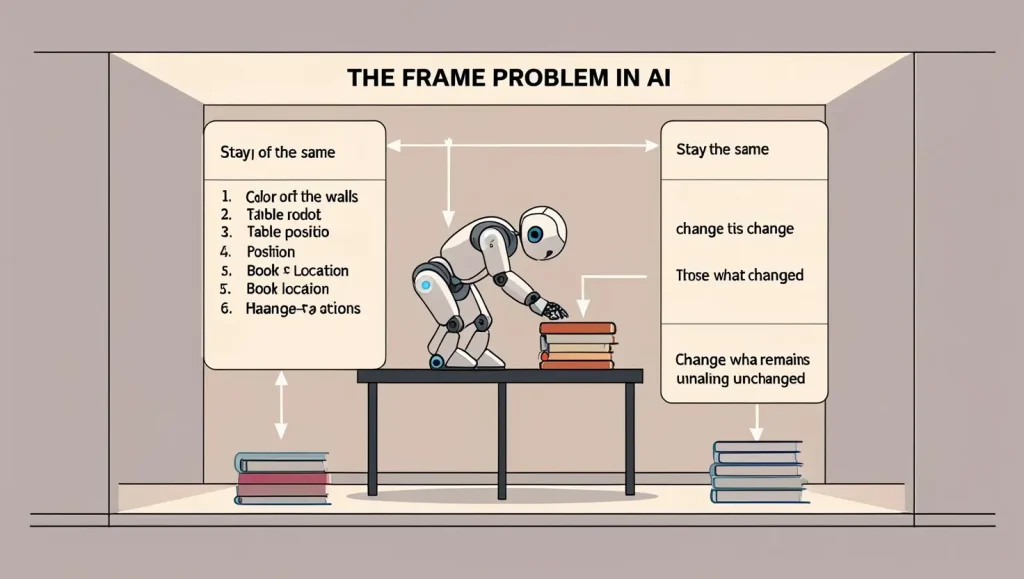
Despite their power, Frames in Artificial Intelligence are not without their challenges. The most significant and philosophically deep of these is the “Frame Problem.” John McCarthy and Patrick Hayes first explained it. It deals with a key problem in AI: figuring out what stays the same when an action happens in a changing world. This problem highlights the limitations of representing knowledge in discrete, static chunks when dealing with the fluidity of reality.
Defining the Frame Problem: What Changes and What Stays the Same?
At its core, the Frame Problem is about relevance. Imagine an AI robot tasked with picking up a book from a table in a room. When it performs the action, it knows the book’s location has changed. But what else has? Is the color of the walls the same? Is the sun still in the sky? Is the table still in the same position? A system based on formal logic would need an astronomical number of axioms to state all the things that remain unchanged. The challenge is to create a system that can efficiently and correctly infer the non-effects of an action without having to explicitly list them all. Humans do this effortlessly through common sense, but formalizing this is notoriously difficult.
Its Significance for Dynamic and Real-World AI Systems
The Frame Problem is not just an academic puzzle; it has profound implications for any AI system that needs to operate in the real world. For robotics, autonomous vehicles, and planning systems, being able to reason about the consequences of actions is paramount. An autonomous car needs to know that braking changes its speed but not the color of the traffic light. A logistics robot must understand that moving a box from one shelf to another doesn’t change the contents of other boxes. Without a good solution to the Frame Problem, AI systems stay fragile and limited to predictable environments. They cannot handle the open-ended nature of reality.
Modern Approaches and Mitigation Strategies

No one solution solves the Frame Problem completely. But researchers have created different methods to reduce it. One approach is the “successor-state axiom,” which defines how each attribute (or “fluent”) can be changed by an action, implicitly assuming it stays the same otherwise. Another technique is the use of non-monotonic logics.
These allow default assumptions that can be withdrawn if new information contradicts them. In modern AI, probabilistic methods and Machine Learning offer a different path. Instead of trying to logically prove what stays the same, these systems learn statistical models of the world. They capture the usual cause and effect patterns without stating them directly. Hybrid approaches that combine structured knowledge (like Frames in Artificial Intelligence) with learned models represent a promising frontier in creating more robust and adaptable AI.
Designing and Implementing Frame-Based Knowledge Bases
Creating a functional frame-based system requires more than understanding the theory. It demands a disciplined approach to knowledge engineering. This process connects human expertise with machine representation. It carefully creates structures that let AI understand a specific domain. It is a complex craft. It blends various fields, including library science, data modeling, and epistemology, which is the study of knowledge. This approach uses many fields of study. It helps the system copy how humans understand things well.
Principles of Knowledge Engineering for Frames in Artificial Intelligence
- Ontological Commitment: Define a clear, consistent set of concepts and relationships for the domain.
- Identify key objects, events, and properties.
- Decide how to organize them into a class hierarchy.
- Reusability: Well-designed Frames in Artificial Intelligence should be:
- Modular.
- Applicable in different contexts.
- Use of Default Values: Default values should represent:
- The most common or likely scenarios.
- Not be overly restrictive.
- Collaboration with Domain Experts: Knowledge engineers must work closely with domain experts to ensure:
- The frame system accurately reflects the nuances of the field.
- Tacit knowledge is properly represented.
Building a Robust Knowledge Base: Practical Considerations
When building a knowledge base, several practical factors must be considered. It is very important that the system can grow and handle more work. The system must handle many frames and relationships without losing performance. It is also important to keep the system easy to update and fix. The knowledge base should be designed in a way that makes it easy for project leads and developers to update, correct, and extend the Frames in Artificial Intelligence over time. This includes clear instructions. It also has a logical and easy-to-understand order. The system also needs a way to handle exceptions and conflicts. Real-world knowledge is rarely simple or perfect.
The Role of Data Science in Populating Frame Slots
In the past, people had to fill the slots in a frame-based system by hand. This was slow and hard. It caused a “knowledge acquisition bottleneck.”” Today, data science and Machine Learning play a vital role in automating this task. Techniques like named entity recognition can extract entities such as people, places, and organizations from text. These entities fill slots. Relation extraction algorithms find how these entities are connected. This synergy helps developers build large knowledge bases. They do this by processing many unstructured contents like articles, reports, and web pages. This speeds up the creation of knowledge-heavy applications.
Frames in Artificial Intelligence: Synergy with Machine Learning and LLMs

Far from being obsolete, the principles of frame-based representation are experiencing a renaissance in the age of deep learning. Large language models (LLMs) are good at recognizing patterns and generating text based on probability. But they often lack the structured facts and reasoning that symbolic systems like Frames in Artificial Intelligence provide. The future of AI lies in combining these two approaches, creating hybrid systems that are both fluent and factually reliable.
Machine Learning for Frame Construction and Slot Filling
Modern AI uses Machine Learning to overcome limits of frame-based systems. Instead of defining frames and slots manually, algorithms learn them from data. They use “schema induction” or “ontology learning” to find concepts and properties in large texts. Models can also fill slots by predicting correct values given context and frame. This turns static knowledge bases into dynamic systems that learn and grow. This combination helps AI create structured and reliable data needed for business automation. It also raises questions about copyright for knowledge made automatically from different sources.
Frames in Artificial Intelligence Role Knowledge Organization
Frames started in cognitive science. They are important in object-oriented programming. Today, they work well with machine learning. Frames in Artificial Intelligence are one of the most lasting and important ideas in Artificial Intelligence. They are much more than simple data structures. They show a basic way to organize knowledge. This helps with reasoning, context, and understanding. Frames act as the design plan for intelligence. They let systems make assumptions and inherit properties. They also connect different pieces of information into a clear whole.
For project leads and developers, understanding frame principles is not just a history lesson; it’s a strategic advantage. It provides the intellectual tools to design more robust, transparent, and intelligent systems. By combining frame-based structures with modern machine learning, we can build AI that predicts well. It also uses a clear, structured model of the world. This mixed method creates better applications. It leads to smarter analysis. In the end, it gives users a more valuable experience. People still search for true AI. The frame framework is still central to this search. It provides the basic structure for future smart systems.